


ON THE OTHER SIDE OF THE MEDITERRANEAN
Your lungs are burning. How many times has your mom told you to stop smoking? As you’re pushing your New Balances uphill on the pedals of your bike, you wish you had listened. You’d drop the damn bike right now, right here, but the music rising through the noise cuts your tantrum short.
Accordion. Amélie Poulain. Paris.
You smile. This city has a way of always playing with your nerves, but still there is no other place like her.
The streets are getting narrower and filled with people. You’re forced to stop your bike. Easels fill the pavement. A canvas crashes to the ground and you hear “Putain!” as painters with stained aprons argue with each other for the next tourist.
It’s your turn to swear. The impact on your back wheel throws you onto your backside. You’re ready to jump at the throat of the idiot.
The man on the bike that hit yours also fell on his butt. He walks up to you and asks if you’re hurt. “Maybe I can buy you dinner sometime, since I just ruined your outfit?” He winks. Ugh. What is wrong with this city? You should be mad, but you can’t.
“I’m looking for le Sacré-Cœur,” you say.
“Of course you are.”
He walks you to the stairs and you gently nod for him to go on his way. You want to live this experience by yourself. The stairs are daunting, but on top of them sits a miracle of Byzantine architecture. You’re walking faster now, each step bringing you closer to the white stone basilica.
Two steps away, a hand closes around your wrist.
“Gift, Madame.”
You’re not even done saying thank you when the man is already telling you a price. You’d have a comeback ready. A gift is supposed to be free. But then you notice how passersby look at them with a snarl. African immigrants, probably undocumented, trying to make ends meet. So you smile and give him the coins.
You’re Black too, but you weren’t treated the same. People see American before they see color here in Europe. You never thought this could be a form of discrimination nonetheless.
You’re about to enter the Sacré-Cœur, and as you put holy water behind your neck, you wonder how a city built on the glory of Christianity forgot that the first true pope was African.
WE DON’T SEE COLORS
Have you ever heard of Saint Victor? Probably not. He lived a long time ago, before France was France and before the European borders we know today. Christianity was not yet widespread in the Roman Empire of the second century.
Despite the bishops who preceeded him, Saint Victor is remembered as the first true pope. Why? Because he consolidated the Church’s influence. He chose Latin as the official holy language over Greek and harmonized the celebration of Easter. Some churches were celebrating the day of Jesus’s death, others three days later on the resurrection. This contributed to aligning church practices.
Alright, enough theology talk. You said he was African? Yes, I did. He came from a region clearly marked as Africa on the map.
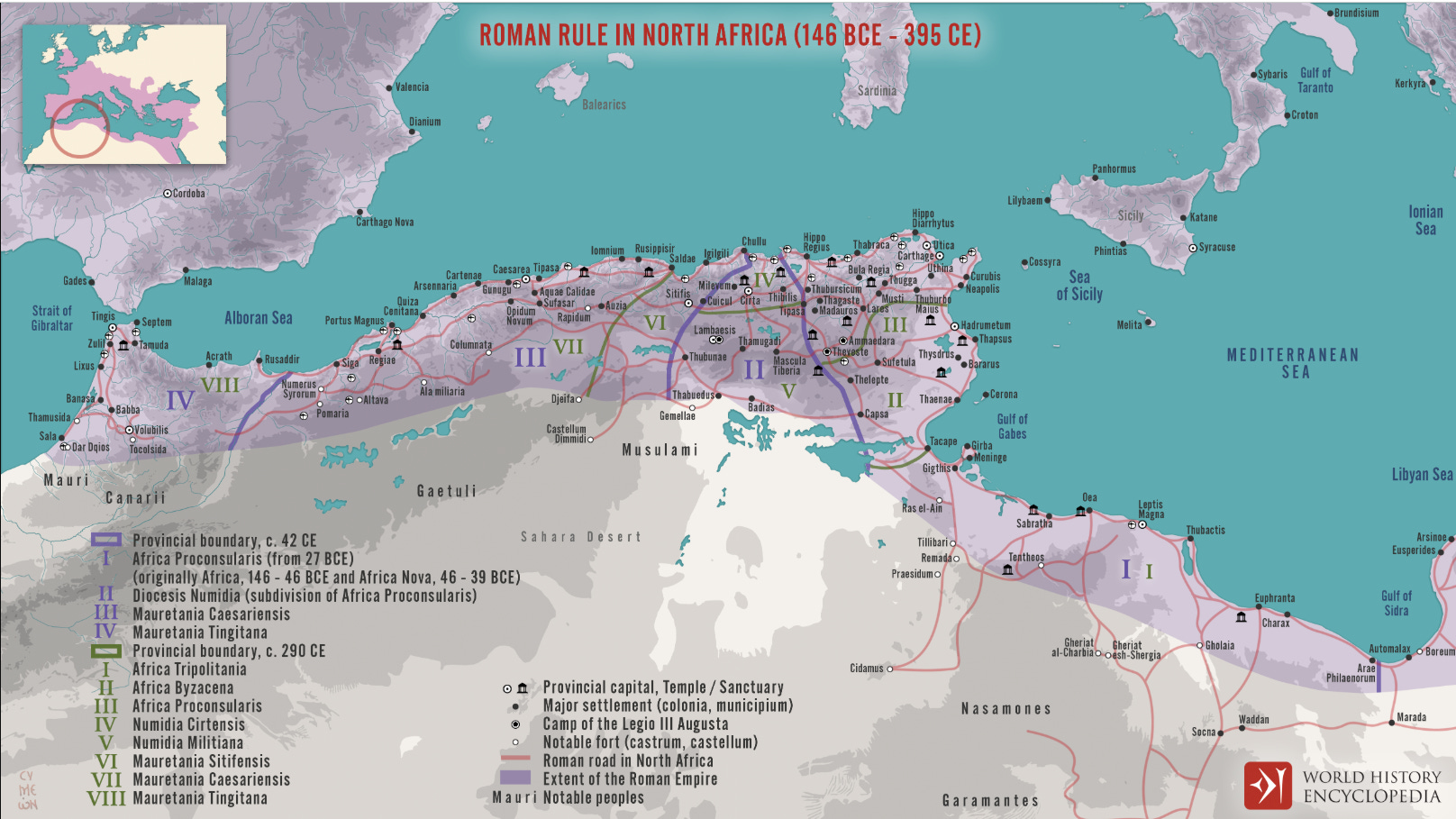
Map: World History Encyclopedia
Look at the purple legend. It shows the region names as they were around the second century, Saint Victor’s era. There is a region clearly named Africa, with one of its main economic hearts being Carthage. Today, it is a suburb of Tunis, the capital of Tunisia. We are not certain Saint Victor lived exactly in Carthage, but it is documented that he was from Africa Proconsularis.
“Well then if it’s Tunisia, he’s not Black. You’re wrong.”
First, there are Black people in Tunisia. It is a fact, and they deal with the same discrimination as Black people all over the world.
Second, I never said Saint Victor was Black. I said he was African. And if you unconsciously made that shortcut, maybe we can drop the identity politics for a minute.
WHY DOES THIS FEEL SO FAMILIAR
Alright, now that we have cleared the air. Why does this matter?
The Sacré-Cœur was built as an ode to Christianity, the same Christianity often invoked by populist parties in France as a symbol of purity of values and tradition. Do you remember I told you in the beginning that its architecture is Byzantine? It is not influenced by medieval European traditions but by the other side of the Mediterranean. The same side Saint Victor was born. The same side Christianity comes from. The same side we repel newcomers.
La France aux Français, which means “France to the French”, is the title of a book written by the historian Pierre Birnbaum. It shows how nationalist movements have used Christianity as a weapon. You are either an ally or an enemy.
Yet they tend to forget that Christianity was born on the other side of the Mediterranean, among the very people they want to send back “where they come from”, even though most of us have only ever known France.
This is obviously anti-immigration rhetoric, but it is also more insidious than that. It implies there are two types of French. Those who fit their fantasy lineage of old French values. They do not say monarchy, but it is very clear where their narrative comes from. And a second kind of French who are racialized, portrayed as too open to other cultures.
But I would argue that between these two groups, who embodies real French values the most? Values of order and tradition belonged to kings and emperors. Republican France’s core value is universalism. You cannot throw universalism at our faces when it fits your arguments about national unity, then conveniently forget it when it is time to think about the future of France.
Black France is still France.
Black France Renaissance is an independent media platform. Our mission is to share a decolonial version of French history where Black people are central.
The Noir Letter features exceptional Black people forgotten by French national history. It extends the discussion from Black France and the French Atlantic slave trade to global abolitionism.
References
Britannica, St. Victor I – Pope of the early Christian Church
New Advent (Catholic Encyclopedia), St. Victor I – Catholic Encyclopedia entry
État de la Cité du Vatican, Saint Victor Ier, pape – Saint du jour
World History Encyclopedia, Map of Roman North Africa (146 BCE – 395 CE)
Persée, Pierre Birnbaum – La France aux Français (analyse historique, politique et sociale)
The National News, Black citizens say racism is still an issue in the new Tunisia