


YOU ARE THE SYMBOL OF FEMINISM
Soap is the only fragrance you know. Your knees hurt. The endless scrubbing is breaking your back. How nice could it feel to wear soft clothes like the ladies who often visit the house? The bell rings, and your wish might just be granted.
Monsieur calls for you.
“Madeleine, it’s enough for today. You’ll wake earlier tomorrow to finish this.”
“Why can’t I finish it now?”
“My wife’s sister wants you to perform some task.” He gestures toward the spare bedroom upstairs.
You oblige. Up there, you find a white woman unconventionally dressed, wearing an apron with her hair pinned up. She is mixing oil pigments while testing the paint consistency on the edge of the palette.
You stop at the white canvas sitting on the easel in the middle of the room. Your stomach churns and your fingers tremble. Did Monsieur tell this woman you could paint her picture? Or maybe she needs someone to help with her affairs.
The brushes sitting on the stool next to her might need some cleaning. You almost grab one, but she catches you by surprise.
“What are you doing?”
“Cleaning, Madame.”
She smiles. “That’s not why you are here. Please, go take a seat.”
The fauteuil behind the easel is covered with a blue fabric. You never get to sit in that kind of bourgeois furniture. The woman’s gaze is still on you, so you avoid the fuss and go sit down. Your weight falls into the padded cushion. A gasp escapes you and you laugh. You could get used to it.
“Now, leave the top out.”
“What?!” You blush, reluctant to obey.
She sighs. “The painting will be shown at an exposition full of men and… well, you know men. They’ll take a better interest if your breast is showing.”
“A better interest… in me?”
“No. In me.”
She moves around the room, hands swirling in the air, seized by a vision.
“You will be a symbol of feminism and women’s wit. With the abolition of slavery, this painting could really propel my career!”
BIG IDEALS AND FRAIL EGOS
Madeleine’s portrait, or the woman who might have been called Madeleine’s portrait, I will explain that in a minute, was painted in 1800.
The date is crucial, but it might not be clear to you because, well, you have not seen the portrait yet.
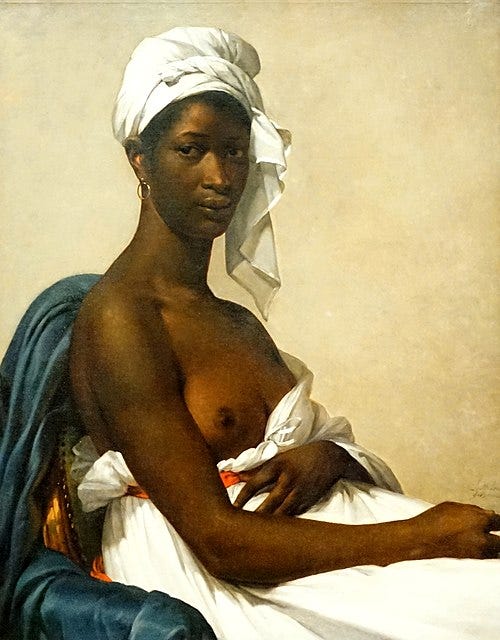
Portrait de Madeleine de M.-G. Benoist
_(47968372388).jpg)
You get it now?
Paintings were an expensive art form. You had to either be from an aristocratic family or from a very successful merchant house to be able to commission one.
So a Black servant woman? Impossible. Unless it was made at the initiative of the artist and for her own benefit.
I told you the date was important. Why? Because 1800 was in the brief window after the French Revolution when slavery was abolished. If you have read my previous article on the Black Woman Napoleon Couldn’t Stop, you would know slavery was first abolished in the French colonies in 1794. Eight short years of freedom before Napoleon reinstated it in 1802.
It is likely that the woman in the painting came from Guadeloupe. It is almost certain she had endured a life of slavery on the island before being sent to France as a house domestic.
Black people were free a few years after the Revolution, you might say. Even if it did not last long, maybe the artist wanted to showcase republican values to the world. Look, she is the subject of the painting, not a servant. The clothes she is wearing have the tricolor of the French flag, blue, red, and white. Surely that should mean something.
Well, not necessarily. She is the subject, yes, and the painting was presented at one of the most prestigious art exhibitions, the Salon de Paris in 1800. But being the subject and having agency are two separate things.
STILL LIFE BUT STILL A LIFE
Remember when I said the portrait of the woman who might have been called Madeleine?
It is because the original painting was not titled with her name. Weird ask by the way, who would care about a black woman’s name in an elite institution at that time.
Portrait d’une négresse. That was the original title of the painting. It means portrait of a nigger.
Yes, France also had its own N word. It had a male and a female version, both just as despicable. This was the female one.
Now that you know the painting’s original name, do you really believe the artist made it driven by new republican ideals and a wish for freedom for all bodies? If that had been the case, the artist would have titled the painting with the name of the woman who posed for it. The painting would not have had to wait until 2019 to give the model a proper identity.
White feminism at the time was not necessarily advocating for Black people’s rights. Historians note that Marie-Guillemine Benoist moved in royalist circles that largely supported the reinstatement of slavery.
Mary Wollstonecraft’s Vindication of the Rights of Woman had been published in 1792, and feminist ideas were starting to take hold in elite women’s minds. Some went as far as comparing their condition to being the slaves of men, while being among the biggest slave owners on mainland France.
Uncomfortable, I know. Enslaved people were considered movable property, which made them easier to inherit than land. Women often inherited slaves through dowries or family estates.
As for the portrait’s name, the modern woman in me feels that justice has finally been served by giving Madeleine a name. But this is more a projection of modern ideals than an acknowledgment of historical truth.
First, we are not even sure her name was Madeleine.
Second, giving her a name in retrospect, while it appeases our guilt, erases the power structure of the time. Madeleine did not ask for her portrait to be painted. She never commissioned it. She never benefited from its success.
Madeleine was painted the way other women artists at the time painted still life. Still, arranged, and with the agency of a fruit basket.
Black France Renaissance is an independent media platform. Our mission is to share a decolonial version of French history where Black people are central.
The Noir Letter features exceptional Black people forgotten by French national history. It extends the discussion from Black France and the French Atlantic slave trade to global abolitionism.
References
Such a good story! I wondered what happened right after she was painted? Just go back to work
Thank you for writing this and sharing it, new things I had no idea about.